Wood Fired Hot Water Heater – Axeman Fire Flue

Get Free Hot Water

With the Axeman Fire Flue

Wood Fired Hot Water Heater
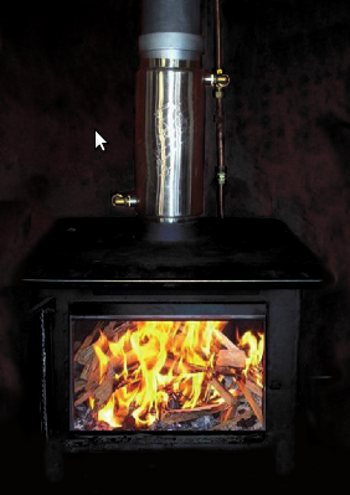
Wood Stove Water HeaterThe Axeman Fire Flue wood fired hot water heater can be easily attached to your wood stove to produce free hot water. This one piece system, made of heavy duty stainless steel, is a water jacket surrounding a central tube. This unit simply fits between your wood stove firebox and your chimney flue.

Save Money and Energy

After heating and cooling, heating water is usually the highest energy consumer in a typical home. Sometimes up to half of a home’s energy consumption is consumed in heating water. The Axeman Fire Flue wood fired water heater is a simple and practical way to utilize heat from your wood stove that may have otherwise been wasted out the chimney.

Simple to Install

The Axeman hot water heater is designed for maximum heat absorption and minimal cost. The unit is simply installed on top of your wood stove by lifting the chimney flue. Insert it into the outlet of the firebox, then lower the flue onto the Axeman water heater.

Connecting to Your Hot Water System

The Axeman Fire Flue hot water heater connects directly to your home’s existing hot water system. Run a pipe from a T off of your cold water line, to the bottom inlet on the Axeman. Then run a pipe from the top outlet to a T at the outlet of your existing hot water heater tank. All connections can be made with common fittings from your local hardware store.

Wood Fired Hot Water Heater

Natural Convection

The top of your hot water tank should be higher than the outlet of the Axeman. This will allow natural convection to circulate the water without a pump. As the water is heated in the Axeman, it rises and flows into your water heater tank. The cooler water at the bottom of your tank flows into the Axeman to be heated by your wood burning fire.

Wood Fired Water HeaterNotes on Installing the Axeman

  • Installation in as little as a hour.
  • For both high and low pressure systems.
  • Three quarter inch fittings for both inlet and outlets. Suitable for copper tubing to be plumbed directly to your existing hot water tank.
  • Uses compression fittings (olive fittings) no welding or soldering necessary.
  • Make sure the outlet on your existing water heater is higher than the water outlet on the top of the Axeman without downward loops that could create air locks.
  • If your hot water tank is lower than the Axeman, a pump will be needed.
  • If you are in doubt, seek the assistance of a plumber or handyman.
  • Insulating all pipes will help prevent heat loss. Pipe insulation can be purchased or made from other materials such as carpet or underlay.
  • When your electric water heating is not needed it can be turned off at the power source.
  • Longer distances from your hot water storage tank will increase heat loss and efficiency.
  • Comes in standard 6″ flue diameter and can be custom ordered for fitting or artistic design at an additional cost.
  • Made in Australia to high standards.
  • Heavy duty construction is designed to handle up to 300 lbs. (almost double the pressure of an average hot water system).
  • Only one of it’s kind being manufactured.
  • Shipping is free anywhere in Australia. Shipping available outside Australia at additional cost.

To order your ‘Axeman Fire Flue’, call today on (03) 6295 0987 and
receive free shipping to anywhere in Australia.
All queries to the number above, or…
Email: axemanfireflue@gmail.com

Download Axeman Fire Flue Wood Fired Water Heater PDF

The Axeman Fire Flue is not distributed by or affiliated with FirewoodResource.com. Please use the contact information above for information about this product.

The Purpose of Fireplace Firebrick and Wood Stove Firebrick

Fireplace Firebrick and Wood Stove Firebrick

Fireplace firebrick is used to line the firebox of steel and cast iron fireplaces and wood stoves. Over time, exposure to the heat and chemicals from combustion can erode the metal on the inside of the firebox. The bricks help to protect the metal walls from the intense heat from the fire. The firebrick lining also acts as an insulator which increases the temperatures inside the combustion chamber for more complete combustion. This increases efficiency and lowers emissions.

Over time the firebricks, also called refractory bricks, can wear down crack and eventually fall apart. Replacement firebricks can be purchased to easily restore the inside of your wood stove or fireplace, which costs much less than replacing the whole unit.

Also consider Soapstone Firebrick. Discover this natural stone’s exceptional durability and its ability to absorb and radiate heat over a long period of time.

What is the Purpose of a Chimney Cap?

There are several functions of a chimney cap. You may already know that an obvious one is to keep the rain and snow out of your chimney. But do you know why it is important to keep water out of your chimney? Chimney caps will cost a little money in the beginning but can save you a lot of money and potential headaches in the long run.

Keeping Your Chimney Dry

You may think there is no need to keep the rain and snow out of your chimney because the heat from the fire will quickly evaporate any water that gets inside. This can be true if you keep your fire hot all the time. But in most cases people don’t keep their fire going 24 hours a day 365 days a year and at some point it is going to get very wet inside a chimney.

Over time water can be damaging to a chimney, especially if it is masonry. Both brick or tile chimneys will absorb water. When you don’t have a fire the inside of a chimney isn’t exposed to the sun and wind so it can stay wet inside for a long time. This can start to damage the masonry over time with extreme temperature changes that happen inside a chimney. When you build a fire and get a sudden extreme temperature change a wet flue can be more likely to crack. In cold weather the water can freeze which can break apart masonry.

A metal liner may be less susceptible to water damage but with some materials like galvanized steel the water can lead to rust. The extreme heat and the chemicals in the smoke and creosote mixed with water can create an environment for corrosion. Not only for your chimney liner but your stove or fireplace can fill with water and the ashes inside can hold moisture for a long time. In one big rain storm I had a stove fill up with water and run out all over the hearth which made a wet ashy mess. The wet ashes and creosote can also produce odors.

Keeping Animals out of Your Chimney

Birds, squirrels, raccoons, rats, mice, cats, all these animals can find their way into an open chimney. Some of them can find their way in and then become trapped and die. In most cases you probably won’t know they are there until the odour pervades your home.

Sometimes birds will build a nest inside your chimney and that will plug it up and the nest will have to be removed before you can build a fire.

I knew a woman who had honey bees build a large hive inside her chimney. She figured that out after she noticed a constant buzzing coming from her wood stove and noticed swarms of bees flying in and out of her chimney. It was kind of funny, most people have smoke coming out of their chimneys but she had bees coming out of hers.

Spark Arrestors Could Save Your Home

Chimney caps with spark arrestors have a screen that is designed to block sparks from coming out of your chimney and starting a fire. Sparks can ignite a roof, walls, or nearby objects such as trees, shrubs and can start wildfires. In some areas a spark arrestor is required by local building codes. Spark arrestors come in different size mesh screens. Some areas like California require a minimum mesh size so check with your local building codes.

Chimney Caps Can Help Prevent Downdrafts

Some chimney cap models are designed to keep air from sinking down your chimney which is called a downdraft. A downdraft can bring cold outside air into your home when your stove or fireplace is not in use. Or when it is in use it can cause smoke to flow into your home instead of out the chimney.