Fatwood Kindling

Fatwood kindling or fire starter is a name that comes form the South. It is made from the heartwood of pines that are naturally saturated with dried resin, also called pitch. Fatwood fire starter is much easier to light than regular wood, it even lights when it is wet. The resin in fatwood kindling will also burn much longer than regular wood kindling.

This wood often comes from stumps of trees or from logs from trees that died standing. Under the right conditions after a pine tree dies, the hartwood will fill up with resin, which eventually crystallizes and hardens. It’s also common in pine stumps. This wood is very resistant to rot and will usually last until it is burned. It is the same material that amber is made from. It is common for the sapwood to rot away from the fatwood and the fatwood will be all that is left of the tree or stump.

It only takes a small amount of fatwood kindling to get a fire started. You can light a piece of fatwood fire starter directly with a match or lighter, no paper is needed. Some people like to cut shavings off of it with a knife to make it even easier to light. I like to break a piece in half while twisting both ends in opposite directions. This sometimes makes it splinter and the splinters are even easier to light.

Forget Firewood Rack Plans, This is Easier

If you are looking for firewood rack plans, you should first take a look at this simple way to build a firewood storage rack. It is so simple that you don’t even need plans. You can quickly build a rack that is very strong, and adjustable from low cost materials.

All you need is some 2×4 lumber and some firewood rack Brackets. And if you want to make it extra string you can add nails or screws, but they are not required.

You take two 2×4’s and cut them to the length that you want your rack to be. Then cut four to the height you want the rack to be and two to the width, which will typically be the length of your firewood pieces. Put the ends of the 2×4’s into the slots in the brackets, and you are done.

The brackets create sturdy right angles between the sets of 2×4’s that can easily hold up your stack of wood. The wood will be held up off the ground and the end uprights will help to make a stable stack.

This type of rack is easy to move and easy to disassemble and reassemble. It is very versatile in size, and you can adjust the size by cutting or replacing the lumber with the size you want. These racks are great for other types of racks, storage racks, work benches, tables, and many things where you need a simple strong right angle between 2×4’s.

How to Measure a Cord of Wood

In order to get a good accurate measurement of firewood, it will help if it is stacked with square corners and even straight sides. An uneven pile will require some estimating and the measurement will not be as accurate.

With a well stacked pile you simple measure the height length and width in feet and multiply them together. This gives you the cubic feet volume. Since a cord is 128 cubic feet you divide your figure by 128 and to find out how many cords of wood you have.

Example: The standard dimensions of  a cord is 4x4x8 feet. Multiply those numbers together and you get 128 cubic feet which is one cord. 4x4x4 is 64 cubic feet divided by 128 is .5 or 1/2 cord. You can also use this simple cord of wood calculator.

If your stacks are not square and even you will have to do some averaging and estimating. For example, if the height varies along the stack take several height measurements in different places along the length of the stack and take the average to use that for your calculation. If the ends of the stack are sloped instead of vertical you will have to estimate where to start measuring the length of the stack.

If the pieces of firewood vary in length, this can make getting an accurate measurement more difficult. Since the length of the pieces determine the with of a row or multiple rows stacked side by side then the with of a row will be uneven. In this case take several measurements to come up with the average length of your pieces to get the width of the stack.

A heaping pile of firewood is really not practical to measure since heaping piles tend to have random dimensions. This can take more serious geometry to figure out the volume. If I try to explain how to do that here I will probably only confuse us both. If you really want an accurate measurement it might be easier to stack it than figure it out. That is if it isn’t a huge pile.

Firewood that is loosely thrown into a square sided container like a pickup bed or a shed can be measured the same as wood that is stacked. Just measure the length with and height and multiply them. If the top of the pile is uneven make an estimate of what the height would be if it was even.

Firewood that is loosely thrown into a pile has more air space between the pieces so a loose cord will take up more volume than a stacked cord. For a loose cord, instead of dividing your cubic foot volume by 128, divide it by 180 cubic feet.

This 180 cubic feet figure is a rough estimate and can vary by how loosely it is thrown together so only consider the measurement of a loose cord to be an estimate and not an accurate way to measure a legal cord.

If you have a question or need something clarified feel free to ask in the public comment section below.

Soapstone Firebrick

For Fireplaces Wood Stoves and Cooking Ovens

Soapstone firebrick is an inexpensive way to transform your wood stove, fireplace or cooking oven into a more efficient and comfortable heating unit. Soapstone is not only a beautiful stone for carving, it also has properties that make it an excellent material for firebrick. Soapstone is a dense non porous stone that is resistant to heat and chemicals. It is very durable under high heat and is known for its ability to retain heat and radiate it over a long period of time even after the fire has gone out.

A firebox lined with soapstone firebricks will tend to reach higher temperatures than traditional ceramic firebrick. This high temperature environment creates a more complete and efficient burn which converts more of your wood into heat while producing less smoke and creosote.

Soapstone has an exceptional ability to absorb this intense firebox heat and slowly radiate it into the room over a long period of time. This heat can still be radiating into your room up to 12 hours after the fire goes out. This creates an even and more comfortable heat instead of the too hot one minute and too cold the next which is typical of wood heat.

Soapstone firebrick is also an excellent material for lining pizza ovens, cook tops, cook stoves, and all kinds of masonry ovens and wood fired cooking ovens.

Get soapstone firebrick and other soapstone products from Southern Oregon Soapstone.

Wood Fired Hot Water Heater – Axeman Fire Flue

Get Free Hot Water

With the Axeman Fire Flue

Wood Fired Hot Water Heater

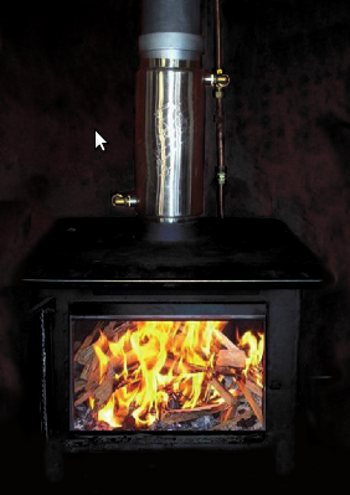
Wood Stove Water HeaterThe Axeman Fire Flue wood fired hot water heater can be easily attached to your wood stove to produce free hot water. This one piece system, made of heavy duty stainless steel, is a water jacket surrounding a central tube. This unit simply fits between your wood stove firebox and your chimney flue.

Save Money and Energy

After heating and cooling, heating water is usually the highest energy consumer in a typical home. Sometimes up to half of a home’s energy consumption is consumed in heating water. The Axeman Fire Flue wood fired water heater is a simple and practical way to utilize heat from your wood stove that may have otherwise been wasted out the chimney.

Simple to Install

The Axeman hot water heater is designed for maximum heat absorption and minimal cost. The unit is simply installed on top of your wood stove by lifting the chimney flue. Insert it into the outlet of the firebox, then lower the flue onto the Axeman water heater.

Connecting to Your Hot Water System

The Axeman Fire Flue hot water heater connects directly to your home’s existing hot water system. Run a pipe from a T off of your cold water line, to the bottom inlet on the Axeman. Then run a pipe from the top outlet to a T at the outlet of your existing hot water heater tank. All connections can be made with common fittings from your local hardware store.

Wood Fired Hot Water Heater

Natural Convection

The top of your hot water tank should be higher than the outlet of the Axeman. This will allow natural convection to circulate the water without a pump. As the water is heated in the Axeman, it rises and flows into your water heater tank. The cooler water at the bottom of your tank flows into the Axeman to be heated by your wood burning fire.

Wood Fired Water HeaterNotes on Installing the Axeman

  • Installation in as little as a hour.
  • For both high and low pressure systems.
  • Three quarter inch fittings for both inlet and outlets. Suitable for copper tubing to be plumbed directly to your existing hot water tank.
  • Uses compression fittings (olive fittings) no welding or soldering necessary.
  • Make sure the outlet on your existing water heater is higher than the water outlet on the top of the Axeman without downward loops that could create air locks.
  • If your hot water tank is lower than the Axeman, a pump will be needed.
  • If you are in doubt, seek the assistance of a plumber or handyman.
  • Insulating all pipes will help prevent heat loss. Pipe insulation can be purchased or made from other materials such as carpet or underlay.
  • When your electric water heating is not needed it can be turned off at the power source.
  • Longer distances from your hot water storage tank will increase heat loss and efficiency.
  • Comes in standard 6″ flue diameter and can be custom ordered for fitting or artistic design at an additional cost.
  • Made in Australia to high standards.
  • Heavy duty construction is designed to handle up to 300 lbs. (almost double the pressure of an average hot water system).
  • Only one of it’s kind being manufactured.
  • Shipping is free anywhere in Australia. Shipping available outside Australia at additional cost.

To order your ‘Axeman Fire Flue’, call today on (03) 6295 0987 and
receive free shipping to anywhere in Australia.
All queries to the number above, or…
Email: axemanfireflue@gmail.com

Download Axeman Fire Flue Wood Fired Water Heater PDF

The Axeman Fire Flue is not distributed by or affiliated with FirewoodResource.com. Please use the contact information above for information about this product.

The Purpose of Fireplace Firebrick and Wood Stove Firebrick

Fireplace Firebrick and Wood Stove Firebrick

Fireplace firebrick is used to line the firebox of steel and cast iron fireplaces and wood stoves. Over time, exposure to the heat and chemicals from combustion can erode the metal on the inside of the firebox. The bricks help to protect the metal walls from the intense heat from the fire. The firebrick lining also acts as an insulator which increases the temperatures inside the combustion chamber for more complete combustion. This increases efficiency and lowers emissions.

Over time the firebricks, also called refractory bricks, can wear down crack and eventually fall apart. Replacement firebricks can be purchased to easily restore the inside of your wood stove or fireplace, which costs much less than replacing the whole unit.

Also consider Soapstone Firebrick. Discover this natural stone’s exceptional durability and its ability to absorb and radiate heat over a long period of time.

What is the Purpose of a Chimney Cap?

There are several functions of a chimney cap. You may already know that an obvious one is to keep the rain and snow out of your chimney. But do you know why it is important to keep water out of your chimney? Chimney caps will cost a little money in the beginning but can save you a lot of money and potential headaches in the long run.

Keeping Your Chimney Dry

You may think there is no need to keep the rain and snow out of your chimney because the heat from the fire will quickly evaporate any water that gets inside. This can be true if you keep your fire hot all the time. But in most cases people don’t keep their fire going 24 hours a day 365 days a year and at some point it is going to get very wet inside a chimney.

Over time water can be damaging to a chimney, especially if it is masonry. Both brick or tile chimneys will absorb water. When you don’t have a fire the inside of a chimney isn’t exposed to the sun and wind so it can stay wet inside for a long time. This can start to damage the masonry over time with extreme temperature changes that happen inside a chimney. When you build a fire and get a sudden extreme temperature change a wet flue can be more likely to crack. In cold weather the water can freeze which can break apart masonry.

A metal liner may be less susceptible to water damage but with some materials like galvanized steel the water can lead to rust. The extreme heat and the chemicals in the smoke and creosote mixed with water can create an environment for corrosion. Not only for your chimney liner but your stove or fireplace can fill with water and the ashes inside can hold moisture for a long time. In one big rain storm I had a stove fill up with water and run out all over the hearth which made a wet ashy mess. The wet ashes and creosote can also produce odors.

Keeping Animals out of Your Chimney

Birds, squirrels, raccoons, rats, mice, cats, all these animals can find their way into an open chimney. Some of them can find their way in and then become trapped and die. In most cases you probably won’t know they are there until the odour pervades your home.

Sometimes birds will build a nest inside your chimney and that will plug it up and the nest will have to be removed before you can build a fire.

I knew a woman who had honey bees build a large hive inside her chimney. She figured that out after she noticed a constant buzzing coming from her wood stove and noticed swarms of bees flying in and out of her chimney. It was kind of funny, most people have smoke coming out of their chimneys but she had bees coming out of hers.

Spark Arrestors Could Save Your Home

Chimney caps with spark arrestors have a screen that is designed to block sparks from coming out of your chimney and starting a fire. Sparks can ignite a roof, walls, or nearby objects such as trees, shrubs and can start wildfires. In some areas a spark arrestor is required by local building codes. Spark arrestors come in different size mesh screens. Some areas like California require a minimum mesh size so check with your local building codes.

Chimney Caps Can Help Prevent Downdrafts

Some chimney cap models are designed to keep air from sinking down your chimney which is called a downdraft. A downdraft can bring cold outside air into your home when your stove or fireplace is not in use. Or when it is in use it can cause smoke to flow into your home instead of out the chimney.

How to Store Firewood Outdoors

There is no one right way to storing firewood, but knowing a few tips on how to store firewood outdoors can help you decide which way will be best for you. When storing firewood outside, the challenge is going to be in keeping it dry. But the advantage is, wood can dry faster when it is outdoors from exposure to sun and wind.

Methods of storing firewood can be different, depending on whether the wood is already dry or not, and what the weather will be like that time of year. If your wood is already dry, the main things are to store the wood so it is off the ground, has cover to keep it dry in wet weather, and is in a convenient and safe location. Be sure and check with local codes and fire department recommendations, since some areas require firewood to be stored a certain distance from structures.

If the wood is already dry, it doesn’t matter that much if you decide to stack it or not. Stacking it is more of a matter of convenience for you. Stacked wood takes up less space, looks nicer and can be easier to cover. Keeping the wood off the ground is important, especially away from soil contact. Wood will absorb moisture from the ground and dirt will stick to the wood and make a mess. It can also cause the wood to decay.

A concrete slab or even putting a tarp on the ground will help greatly. But don’t expect the bottom pieces to stay dry. This is where a firewood storage rack can be a big advantage in keeping the wood off the ground.

Dry wood should be covered if there is gong to be any wet weather. A passing rain shower followed by a stretch of dry weather well before it will be burned, is not going to be much of a problem. But dry wood should be covered before any stretch of wet weather if it is close to time to burn it. Covering firewood with a tarp is probably the most common way to cover it. This can work fine, but it is best to leave the sides of the pile uncovered for air flow. Only cover the top of the pile so any moisture that does get in can escape out the sides.

If you get wood that is wet or green, it is best to choose a sunny location to help dry it. And if you can put it in a place where it will also be exposed to more wind, that is all the better.

It is common for people to want to cover wood that is stored outside when they get it. If the wood is already wet, this is not always a good idea. Covering wet wood will slow down the drying process by blocking air flow and sun exposure. If the wood is green or very wet, sometimes it is best to just leave it out in the rain since it is already saturated anyway. If the wood is covered by a tarp, it is not going to dry much, if at all, and it can hold moisture in and lead to mold, fungus and decay. If it is already partly dry, you may want to keep the rain off but be sure it can still get air. If you feel you need to keep the rain off, only cover the top of the pile, leaving the sides exposed so air can flow through. After the rain is passed, it is best to uncover it so it will dry.

There is also debate about whether to stack the wood or to leave it in a heaping pile. In side by side tests, I have found that stacking wood does allow it to dry faster outdoors, but only if there is space for air to flow between stacks, and especially if there is only one long stack out in the open air and in the sun. The advantage of a single stack is you don’t have multiple stacks shading each other.
Why Modern Wood Splitting Mauls Suck

If you are looking for a new wood splitting maul, beware of modern mauls. The design of traditional style 6 and 8 lb. mauls have changed in recent years. Apparently the engineers who are designing splitting mauls, don’t spend a lot of time splitting firewood. In every store I have looked at, they all have this new inferior design.

With the old style splitting mauls there was a fairly consistent narrow taper from the tip back. Much wider than an ax of course, but still relatively narrow. But with the new mauls, the tip has a very blunt angle right at the tip. Then back a half inch or so, it goes to the more normal narrow taper. If anything, this is the exact opposite of how a maul should be made if you want it to split wood. With this blunt angle, trying to split wood with the new mauls is only a little better than hitting the wood with blunt sledge.

If you have any old splitting mauls that are actually good for splitting wood, you might want to save the heads when the handles wear out. You will probably be better off replacing the handle instead of buying a new maul. Or if you don’t have a good maul, you may be able to shape the new maul into a usable shape if you have a good grinder and plenty of patience. But this will require removing a lot of metal.

To the splitting maul manufacturers, please start building splitting mauls that are actually good for splitting firewood.


Copper Outdoor Fire Pits

Copper fire pits are one of the most popular types of fire pits sold today. There are many advantages to copper for firepits, but it also has its disadvantage. Determining which will be best for you will depend on your outdoor fire needs.

One of the main reasons people choose copper, is for its durability and longevity. Copper has a very high melting point and a strong resistance to corrosion. Copper does not rust like cast iron or steel. Exposure to the extreme heat and weather will cause iron to corrode especially fast. For thin material, this can mean a short life. Thick iron or steel can still last a long time, but the rust can wash off in the rain and stain your patio or deck. With copper, this just isn’t a problem.

Another advantage of copper fire pits is the appearance. To a lot of people, copper looks more elegant, and will retain its appearance, even with exposure to use and weather. Copper will form a thin patina from oxidation, but can be polished back to its original shine. But many people prefer the appearance of the patina and leave it.

The main disadvantage of copper is the price. Copper is significantly more expensive than other common fire pit materials. But if you plan on keeping a fire pit for a long time, it can be worth the extra cost. Copper is also heavy, so may not be the best material for a portable fire pit, but so is cast iron and steel. Cast aluminum has the weight advantage.

Coper is ultimately considered to be the best material for fire pits by most people. If you don’t mind the extra cost, this may be the way to go.