 Pseudotsuga menziesii
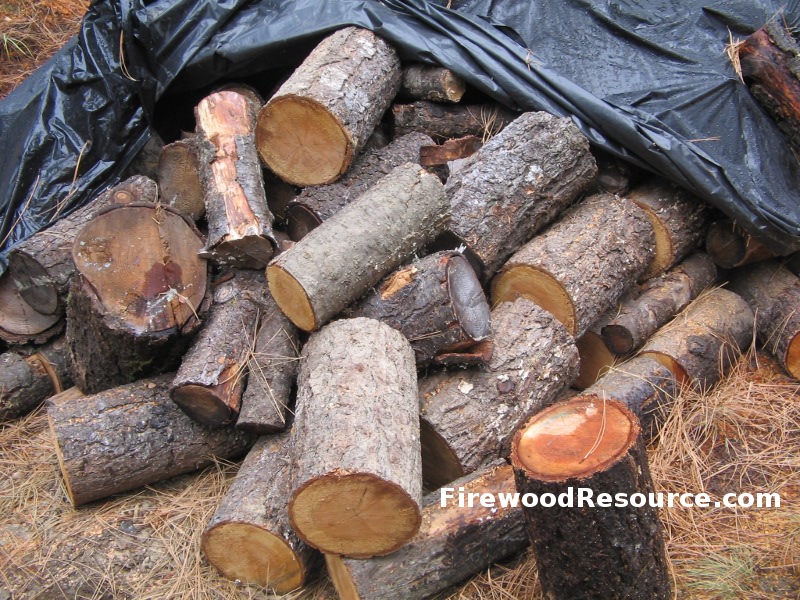
Douglas Fir is a softwood that produces a moderate amount of heat and is easy to light. Douglas Fir is one of the better softwoods for firewood and is even better than some hardwoods as far as total heat content.
Douglas fir that is straight grained and knot free splits nicely into kindling size pieces. It is often used for kindling but being denser than most other softwoods doesn’t ignite as easily so is not the best choice compared to many other softwoods.
Douglas Fir is not a true fir but is in a genus of it’s own. Douglas Fir ranges from central British Columbia to central California along the Pacific Coast and also in the Rocky Mountains.
Post your comments about Douglas fir firewood
Split Douglas Fir ignites easier than any other softwood in North America. Try it for yourself.
We just started to burn Douglas Fir (Santa Rosa, California). We burn small hot fires because it is a very sappy wood. We can easily overheat if we put in to much. The pockets of sap we find while splitting we turn into fire starting sticks … super convenient.
I stay away from fir, because of all the branches. Nice to find a tree that soars into the sky, and 60+% of if from the root is limb free. Getting a winters worth of firewood is enough work without having to delimb and then dispose of high density branches.
how long does it take doug fir to season? i live in oregon and it isn’t very humid. had some cut down and split about 2 weeks ago, will it be ready to burn this winter?
I really enjoy burning Doug fir. It splits easy since it’s a straight grained wood, and throws a decent amount of heat for a lengthy period of time with nice HOT coals in a wood stove. 2-3 good size pieces in the woodstove and I’m toasty warm all night here in Idaho. I would certainly go out of my way for doug fir as it ranks high on my list of firewood types.
Douglas fir is my second favorite firewood. (first choice oak). Very pleasant aroma, long hot coals, and burns pretty clean. It also seasons pretty quick. A year is plenty of time and can even be ready if you get it cut, split and stacked in early spring —it usually seasons by the following winter to burn. Just be careful when handling it as it’s very splintery. Gloves are the solution.
The sap is referred to as when a tree has gone resinous. Created when fir beetle bore to the heart of the tree ,the trunk 3-12 feet . To the core then verticle exuting the top . In a two year cycle . Can put a full grown health Doug fir . Into a dying process. Anyway maybe I should save it for another columnn dueces. Thanks tom
One of the best options we have out here in Northeast Oregon. Can be hard to split because of all the knots, but burns hot and long. Smells good too!
I’m in the west central Idaho mountains near McCall. Around here wood cutters sell what they call “Red Fir”. Is this really Douglas Fir or another less desirable species? (ie. 15-20% less energy potential)?
Ed, I live in North Idaho & people call it red fir here too but I’m pretty sure it’s Douglas Fir. Burns good & splits easily. I have tamarack, Doug fir, lodgepole pine, ponderosa pine, grand fir, birch, & cedar on my property.. I burn them all in my stove I am not picky.. but the Doug fir is near the top of my list for heat and availability.
I know this is an old thread, but I love Douglas fir for burning in my woodstove. Here I am sitting in my living room with the early evening fire dying down to embers. 100% Douglasfir fire. It’s almost too warm in here.
I love it because,
a. It lights easily.
b. It puts out plenty of BTUs for my needs.
c. Compared to maple, oak, ash, Walnut, it leaves hardly any ash at all.
d. It splits like a dream.
e. Doesn’t gunk up my flue with loads Creosote. Admittedly, I have an excellent draft on my fireplace insert, but every time I have my flue cleaned my flue cleaning guy always says, “your flue is in excellent condition you must be burning right.“
f. At between $175 and $250 per cord, it’s much cheaper than a hardwood, so if you have to buy a lot of firewood to heat your home each winter, it’s easier on the pocketbook.
g. It’s relatively lightweight. Makes it easy to stack and an easy chore to load the wheelbarrow and wheel over to fill my wood box.
Couple years ago I got given an entire English walnut tree which had to be taken down. I ended up with almost 7 cords of firewood split and stacked. It heated about the same as Oregon big leaf maple, but left a TON of ash. Seriously, I’d never go out of my way to look for walnut to burn ever again. I was shoveling buckets of ash out of my woodstove every single week. It was ridiculous. Absolute mountains of the stuff!
For this winter’s heating heating (2021), I bought five cords of very nice, seasoned, split Douglas fir this summer @ $250 per cord delivered, and I am extremely happy with it. At 20.7 million BTUs per cord, it does not have the BTU output that Oregon White Oak or Oregon Ash does but that’s OK. I don’t get sub arctic weather here in Western Oregon. Fir heats beautifully for my needs. You can’t really go wrong with it, just don’t expect it to coal up like oak does. It won’t do that. But it doesn’t really matter. I just get my main living area has a temperature I want it and if it isn’t freezing weather in the teens outside, I let the fire go out and then restart it in the morning if I need to. I’m not going through the wood super fast and I’m 100% comfortable temperature wise.